Mastering Low-Lag Trends: The Qema Direction Indicators Explained
Moving averages are foundational cornerstones in technical analysis, smoothing out volatile market movements to reveal core trend directions. However, classic calculation metrics like the Simple Moving Average ($SMA$) or Exponential Moving Average ($EMA$) inherently force a frustrating compromise upon retail traders: tracking long-term trends introduces deep lag that delays execution, while speeding up the period settings results in excessive false signals during market chops. Qema Direction Indicators completely solve this structural trade-off by using advanced Quadruple Exponential Smoothing mathematics to map highly accurate, low-lag momentum paths.
Here is an analysis of how this next-generation processing engine works and how you can deploy it to capture explosive market extensions.
The Architecture of Quadruple Exponential Smoothing
The acronym QEMA stands for Quadruple Exponential Moving Average. While a traditional moving average treats historical price points with uniform or linear data weightings, multiple-layered averages iteratively calculate the results of prior loops to shave off data delay. Where a standard Double ($DEMA$) or Triple Moving Average ($TEMA$) runs two and three mathematical loops respectively, QEMA processes a comprehensive four-tiered calculation framework.
By mathematically neutralizing the calculation lag that plagues regular lagging indicators, the QEMA curve adapts aggressively to real-time price distribution. The result is a highly polished indicator line that tightly hugs active price expansions while preserving its structural smoothing integrity during minor intraday noise.
Reading Trend Changes on Your Chart Terminal
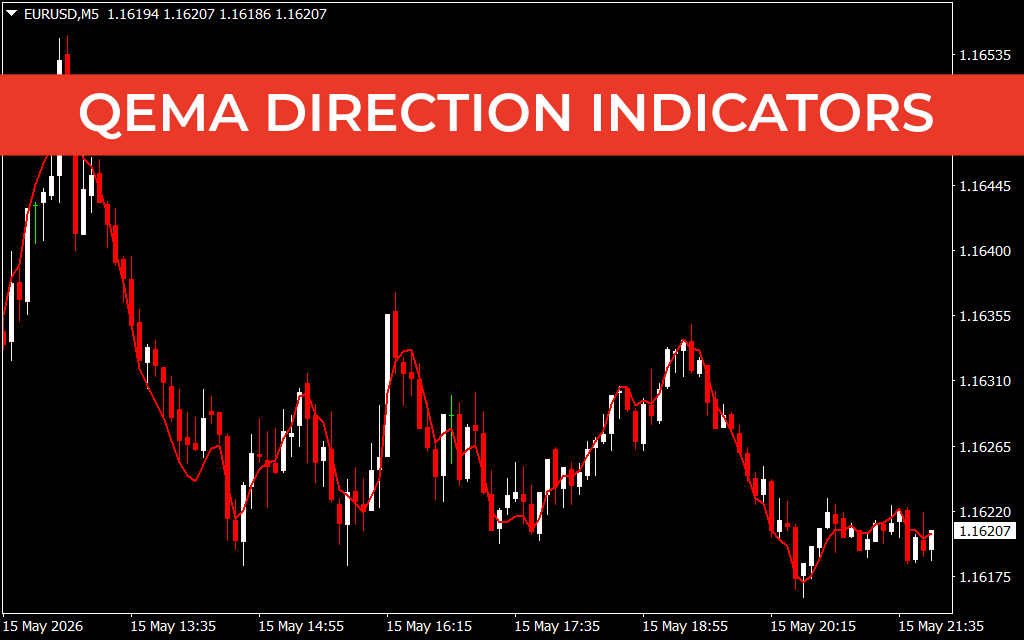
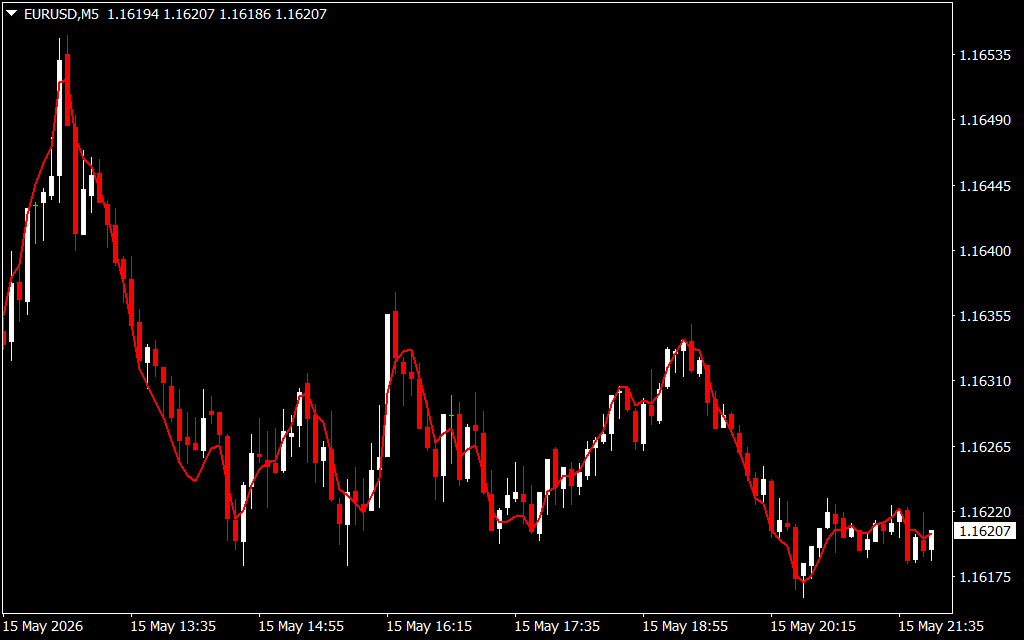
As showcased on the EUR/USD M5 chart, the Qema Direction indicator delivers highly actionable, scannable data layouts directly onto the candlestick window. By functioning as a dynamic overlay, it keeps your technical workspace completely clean and clutter-free:
- The Bullish Expansion Zone: When buying pressure sweeps into the market, the price candles trade decisively above the indicator baseline. The QEMA curve shifts to act as a dynamic trailing floor, rising smoothly underneath the ascending swing lows to visually confirm a healthy markup phase.
- The Bearish Liquidation Zone: Conversely, when institutional distribution drives prices lower, the candles print beneath the indicator boundary. The QEMA line angles downward, transforming into a tight overhead resistance ceiling that caps corrective intraday retracements.
- The Momentum Incline: The actual slope of the QEMA curve acts as an immediate visual measurement of trend velocity. A steep, aggressive vertical angle highlights strong institutional backing, while a flat, horizontal profile provides an early warning to avoid taking trades due to an impending low-volume trading range.
Professional Strategies for Intraday Terminals
To extract maximum structural value from the Qema Direction system, incorporate these execution methodologies:
- Precision Candle Closures: To protect your capital from intra-candle spikes, only log a fresh trend entry when a 5-minute or 15-minute candlestick closes completely on the opposite side of the QEMA line.
- Volatility Stop Trailing: Utilize the physical path of the QEMA indicator as an objective rule-based stop-loss engine. As a strong trend accelerates, continuously adjust your stop order just beyond the indicator line to seamlessly secure accrued equity.
- Multi-Timeframe Macro Filtering: Improve your win rates by loading the QEMA engine onto a higher timeframe (like H1 or H4) to establish your major daily market bias. Only trade lower-timeframe execution setups that align precisely with the larger macro-structural curve.
2 Downloads
Last Update:
May 17, 2026 01:59 AM
Published:
Jan 20, 2026 22:55 PM
Category: