Master the Chaos with the Signal To Noise Filter Indicator
In the financial markets, Price Action is a constant battle between meaningful trends and random fluctuations. For traders—especially those focused on precision on the M30 and intraday timeframes—the biggest challenge is avoiding "noise" that leads to false breakouts and overtrading. The Signal To Noise Filter (often powered by algorithms like the Damiani Volatimeter) is a professional-grade tool designed to distinguish between high-conviction market moves and directionless volatility.
The Science of Signal vs. Noise
Every market movement consists of two components: the Signal (the underlying trend driven by institutional order flow) and the Noise (minor price wiggles caused by retail activity and low liquidity). Most indicators fail because they treat both components equally. The Signal To Noise Filter uses a complex volatility-comparison algorithm to determine if the current market energy is sufficient to support a sustainable trade.
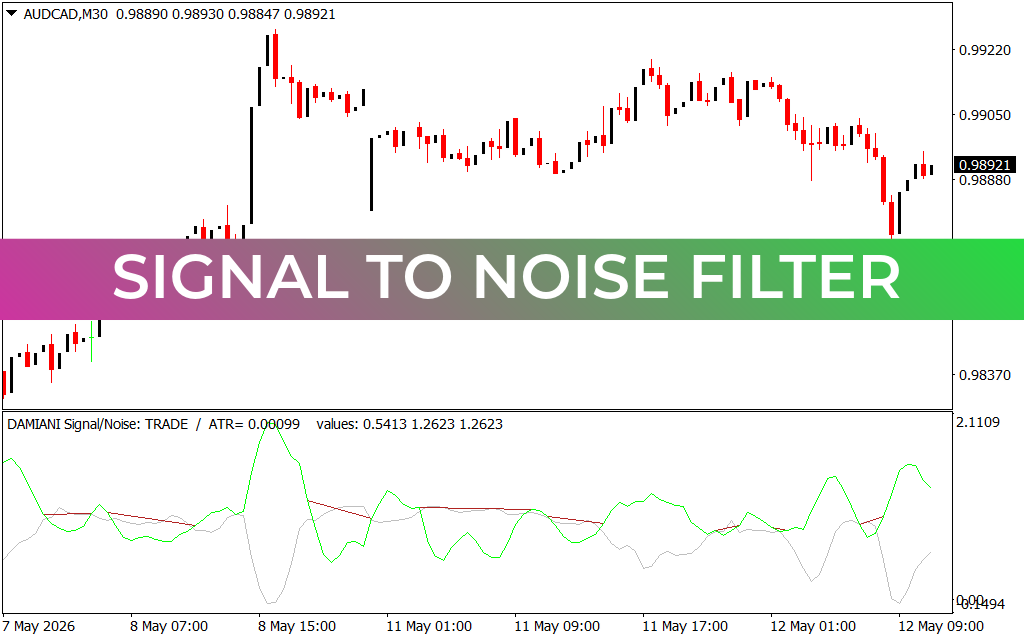
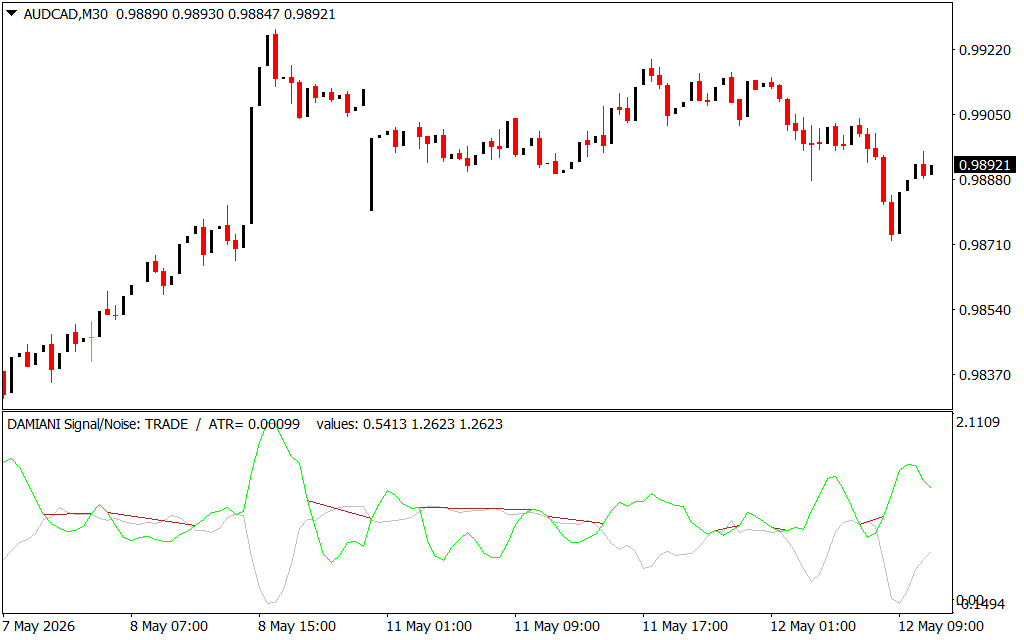
As shown in the AUD/CAD M30 chart, the indicator appears in a sub-window with two primary lines—a green signal line and a gray noise line. The relationship between these two lines provides an objective "Go/No-Go" gauge for your trading strategy.
Decoding the Volatility Thresholds
The Signal To Noise Filter simplifies market complexity into a binary decision-making process:
- Green Above Gray (The "Trade" Zone): When the green line crosses above the gray line, the "Signal" is stronger than the "Noise." This indicates that the market is in a trending phase with enough momentum to reach technical targets. In the provided AUD/CAD example, the peaks in the green line perfectly correspond with the most tradable legs of the trend.
- Gray Above Green (The "No Trade" Zone): When the noise line is dominant, the market is effectively "sideways" or erratic. This is a clear warning to stay on the sidelines. Trading during these periods often results in "whipsaws," where price hits your stop loss before moving in your intended direction.
- The Zero-Line Threshold: The indicator often includes a horizontal threshold. When both lines are flat and low, it signals a period of extreme compression—the "calm before the storm"—where a breakout is imminent.
Strategic Benefits for Disciplined Traders
- Eliminate Overtrading: By only taking setups when the "Signal" is dominant, you naturally reduce the number of low-probability trades in your journal.
- Improved Risk Management: Knowing when volatility is "noisy" allows you to avoid entering trades where stop-loss placement is difficult due to erratic price spikes.
- Enhanced Confluence: This filter is the perfect companion for Smart Money Concepts (SMC) or trend-following systems. A "Change of Character" (CHoCH) on the price chart is significantly more reliable if the Signal To Noise Filter confirms a surge in meaningful momentum.
- Adaptability: While showcased on the M30 timeframe, the indicator’s logic is robust enough to filter out noise on the M1 for scalpers or the Daily chart for swing traders.
Strategic Implementation
The Signal To Noise Filter is best used as a final confirmation gate. If your primary strategy issues a buy or sell alert, check the sub-window: if the green line is not clearly above the gray line, the market is likely just "making noise." By waiting for that green-over-gray alignment, you ensure that you are trading with the wind at your back, focusing your capital only on moves backed by genuine market conviction.
4 Downloads
Last Update:
May 12, 2026 14:23 PM
Published:
Jan 23, 2026 17:59 PM
Category: