Master Market Smoothness: Ultimate Guide to the T3 Moving Average Indicator
In the realm of technical analysis, moving averages are foundational tools for identifying trend direction, dynamic Support And Resistance levels, and potential entry zones. However, traditional variations present a persistent trade-off. The Simple Moving Average (SMA) is smooth but introduces significant lag, often making you late to a trend reversal. Conversely, the Exponential Moving Average (EMA) reduces lag but is highly susceptible to whipsaws and false signals during choppy, low-volume consolidation phases.
To bridge this mathematical gap, legendary developer Tim Tillson introduced a superior alternative: the T3 Moving Average. By combining multi-layered exponential smoothing matrices, this institutional-grade indicator effectively eliminates lag while maintaining a remarkably smooth trajectory, giving technical traders the ultimate edge in trend tracking.
What is the T3 Moving Average Indicator?
The T3 Moving Average is an advanced trend-following overlay engineered for modern financial assets. Unlike standard moving averages that compute a single calculation loop, the T3 algorithm utilizes a sophisticated sextuple-smoothing process. It processes the price data six consecutive times through an internal DEMA (Double Exponential Moving Average) matrix, adjusted by a specialized volume factor or damping coefficient (often referred to as the $b$-value).
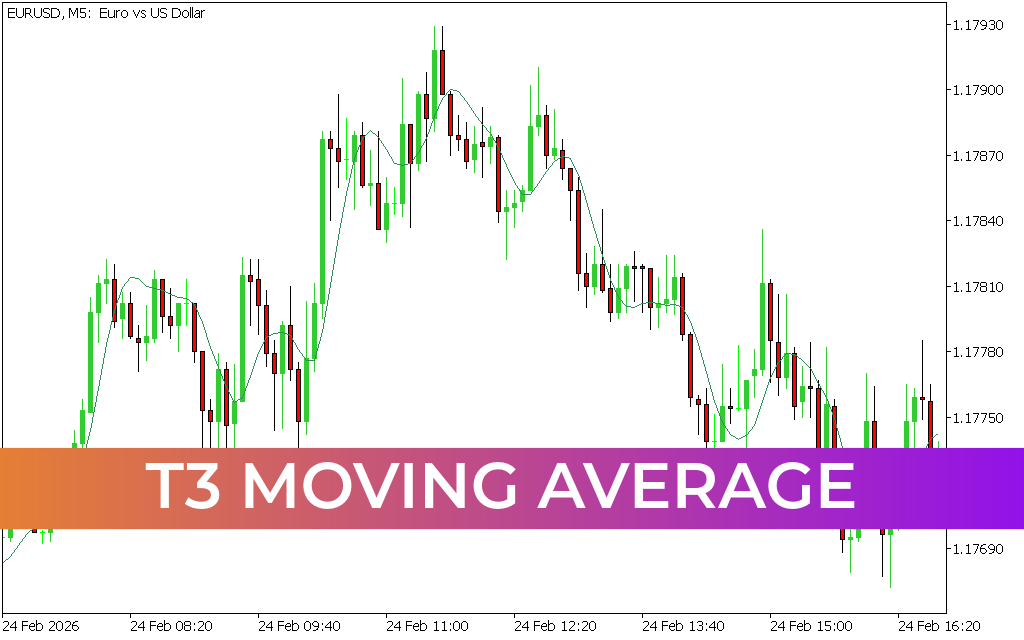
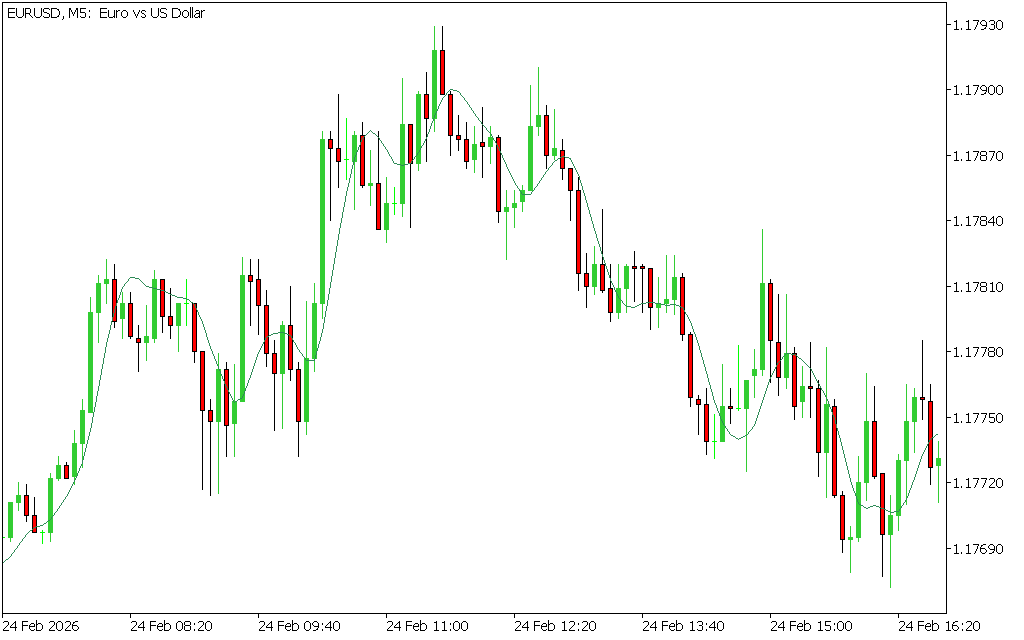
As demonstrated in the EUR/USD 5-minute (M5) chart above, the indicator overlays a single, highly adaptive dark green line natively across the candlesticks. Instead of reacting erratically to minor intraday price spikes or lagging far behind rapid structural breakouts, the T3 line fits the Price Action smoothly. It allows you to visualize the real underlying direction of institutional capital with absolute clarity.
Key Features and Strategic Advantages
- Ultra-Low Lag Smoothing: Employs Tim Tillson’s proprietary sextuple-smoothing mathematics to react to real structural shifts significantly faster than standard SMAs or EMAs.
- Whipsaw Protection: The adjustable damping coefficient filters out fractional, low-volume price variations, preventing premature stop-outs during choppy market regimes.
- Dynamic Support and Resistance: Functions as a reliable, fluid boundary where institutional buyers and sellers step in to defend major trend expansions.
- Seamless Scalability: Operates flawlessly across any charting horizon, offering fast-paced M1 and M5 scalpers the exact same mathematical reliability required by daily macro swing traders.
How to Trade with the T3 Moving Average
Integrating the streamlined T3 moving average into an active trading routine provides a highly efficient baseline for mechanical trade execution:
- The Structural Trend Filter: When the price action stays securely above the green T3 line, the market is in an established bullish expansion phase. Focus exclusively on long (buy) setups. When the candlesticks trade consistently beneath the T3 curve, an institutional markdown phase is underway, shifting your priority to short (sell) opportunities.
- Dynamic Pullback Entries: During a strong trend, price will periodically pull back to rest directly on the T3 line. Look for rejection candlestick footprints—such as pin bars or engulfing patterns—exactly at the T3 line to time high-probability, low-risk continuation entries.
1 Download
Last Update:
May 24, 2026 03:05 AM
Published:
Jan 15, 2026 15:14 PM
Category: