Master Market Volatility with the Adaptive ATR Indicator
Managing risk is the absolute foundation of long-term trading profitability. While finding an entry point is important, knowing exactly where to place your stop-loss and how to adjust your position size based on current market behavior is what keeps retail accounts from blowing up. The traditional Average True Range (ATR) indicator has long been the standard tool for measuring market volatility. However, standard calculations often fail to keep up during rapid transitions between quiet consolidation and high-impact breakouts. The Adaptive ATR indicator addresses this issue by automatically tuning itself to shifting market cycles in real time.
Here is an analytical look at how this advanced Volatility Indicator operates and how you can use it to build a highly resilient trading strategy.
What is the Adaptive ATR Indicator?
The Adaptive ATR indicator is a dynamic technical tool displayed in a dedicated sub-window below your primary price chart. Unlike the classic ATR, which applies a static, fixed look-back period (typically 14 days), this optimized version incorporates an adaptive smoothing mechanism. It constantly scales its sensitivity up or down depending on localized market velocity.
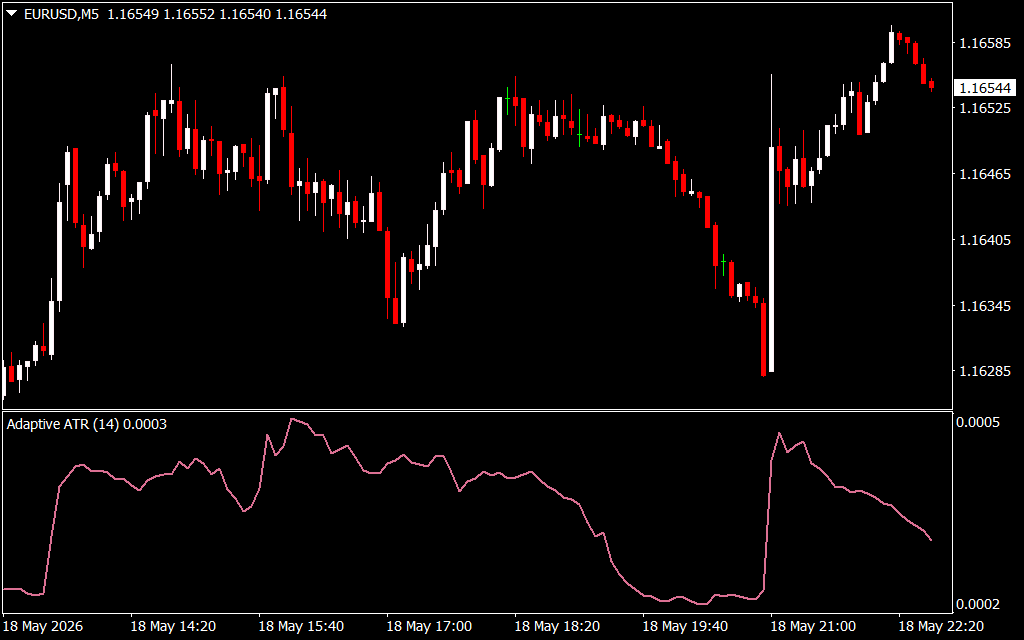
- High/Spiking Signal Lines: Indicate an environment of accelerating price expansion, aggressive institutional volume, or high-impact macroeconomic news releases.
- Low/Flattening Signal Lines: Indicate a tightening market matrix, typical of low-liquidity sessions or critical periods of consolidation preceding a major breakout.
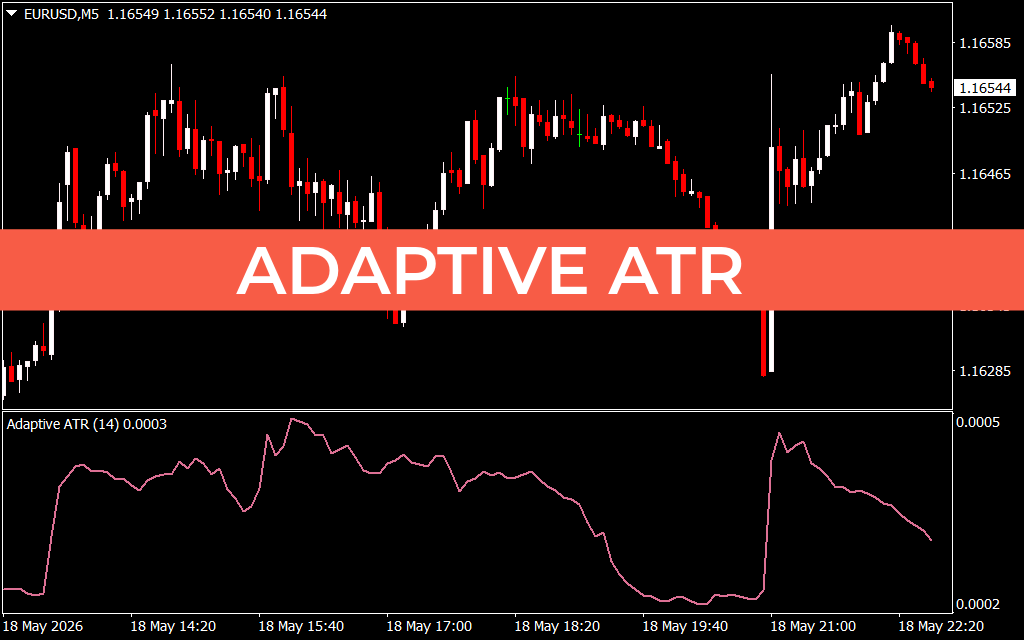
As displayed on the EURUSD M5 chart, the indicator tracks changes in market behavior flawlessly. When the asset experiences a massive vertical price drop, the pink signal line instantly surges toward the upper parameter threshold ($0.0005$), signaling a massive expansion in real-time volatility.
Crucial Advantages for Technical Analysts
- Dynamic Stop-Loss Placement: By providing an accurate reading of localized market noise, it ensures your stop-losses are wide enough to survive random market whip-saws during high volatility, yet tight enough to maximize your risk-to-reward ratio during quiet periods.
- Automated Cycle Adjustments: The indicator eliminates the need to manually tweak input settings when moving from quiet Asian session ranges to volatile New York session breakouts.
- Objective Breakout Confirmation: When price approaches a key support or resistance level, an advancing Adaptive ATR line confirms that genuine structural momentum is backing the move.
Practical Trading Implementations
To maximize your success with the Adaptive ATR on platforms like MetaTrader, integrate it using these two core methodologies:
- The Volatility-Based Trailing Stop: Multiply the current Adaptive ATR value by a fixed factor (such as $2.0$ or $3.0$). Use this shifting point value to trail your protective stop-loss behind an active trend. This ensures you give a running position breathing room when volatility expands and lock in profits quickly when the market slows down.
- Smart Position Sizing: Before entering any market order, check the current readout of the indicator. If the value is high, reduce your lot size to maintain a constant risk profile. Conversely, when the line bottoms out near $0.0002$, you can safely increase your position size since the technical invalidation level is structurally closer.
3 Downloads
Last Update:
May 19, 2026 01:42 AM
Published:
Jan 19, 2026 20:48 PM
Category: