Master Risk Management with the Ulcer Index Indicator for MT4
In the world of professional trading, the focus is often disproportionately placed on potential returns, while the "pain" of the journey—drawdown—is ignored. High volatility can lead to emotional decision-making, causing traders to abandon sound strategies during temporary dips. The Ulcer Index (UI) for MetaTrader 4 (MT4) is a specialized risk-management indicator designed to solve this problem. Unlike standard volatility measures like Standard Deviation, which penalize both upward and downward movement, the Ulcer Index focuses exclusively on "stressful" downward Price Action, providing a true measure of investment risk and strategy stability.
The Science of Stress-Free Trading
Developed by Peter Martin and Byron McCann, the Ulcer Index measures the depth and duration of price declines from earlier highs. The greater the value of the UI, the longer it takes for an asset to return to its previous peak, indicating a higher level of "ulcer-inducing" risk.
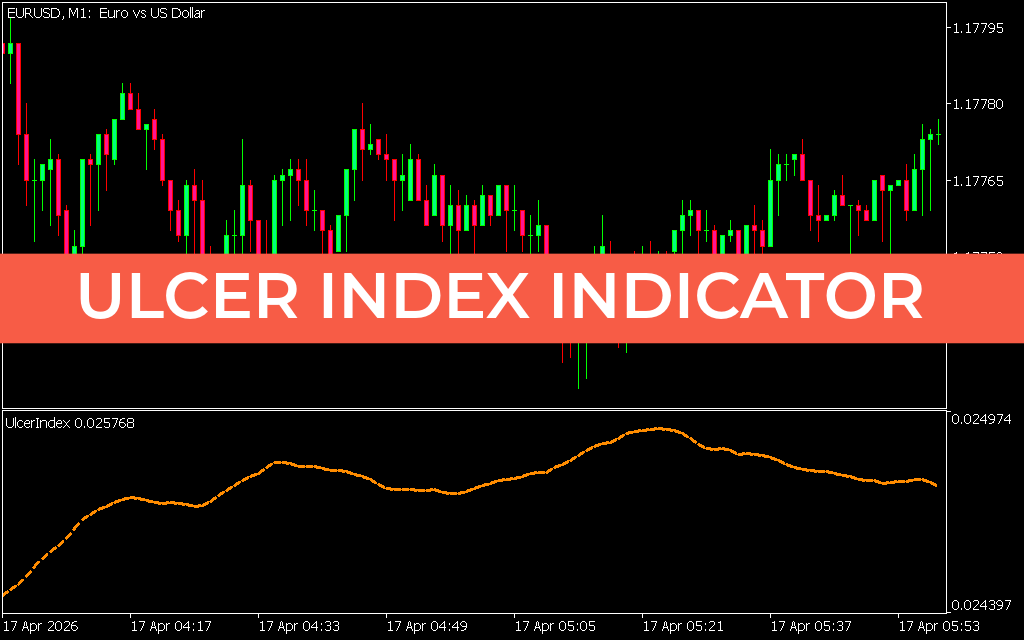
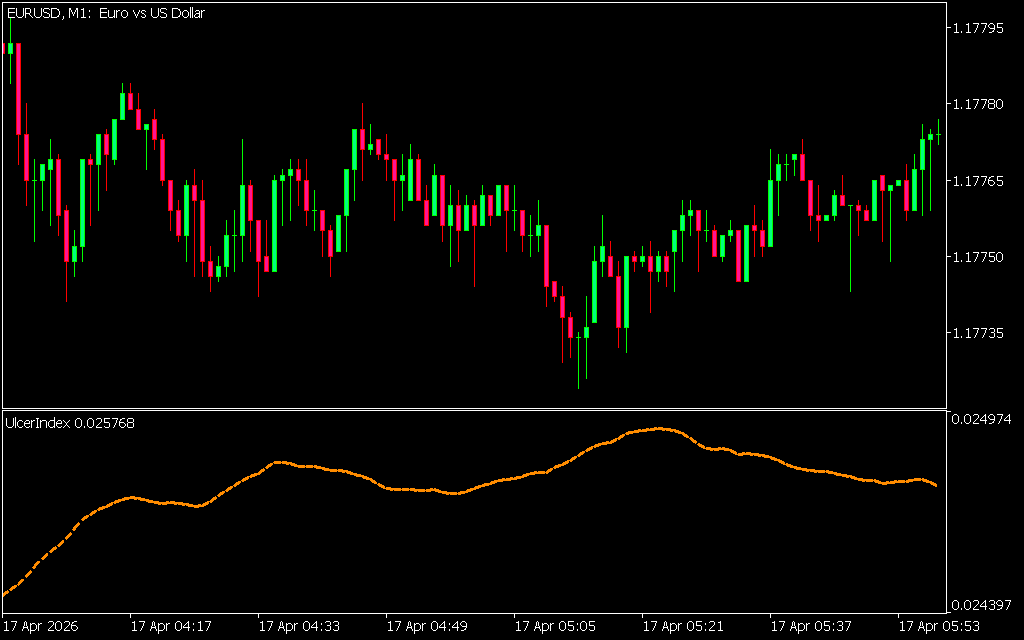
As observed in technical analysis on liquid pairs like EUR/USD on the M1 timeframe, the Ulcer Index provides a definitive operational advantage:
- Pure Downside Risk Assessment: Most indicators treat a massive upward spike the same as a massive downward crash. The UI is mathematically tuned to ignore "good" volatility (upside) and focus solely on drawdowns. As seen on recent M1 charts, this allows traders to identify which pairs or strategies are truly safe to hold during periods of market uncertainty.
- Identifying Strategy Exhaustion: For systematic traders, a rising Ulcer Index is an early warning sign. If the UI begins to climb significantly above its historical average, it suggests that the current market regime is no longer favorable for your strategy, allowing you to scale back before a major equity hit occurs.
- Comparing Asset Stability: The UI is an exceptional tool for portfolio diversification. By comparing the Ulcer Index of EUR/USD against a more volatile pair or index, you can objectively see which asset offers a "smoother" ride, helping you allocate capital to instruments with higher risk-adjusted returns.
- Visualizing Recovery Time: The UI doesn't just look at how far price fell; it looks at how long it stayed down. A "spiky" UI suggests a quick recovery, while a plateaued UI indicates a grinding bear market, providing essential context for exit and re-entry timing.
Strategic Implementation for Professional Risk Control
The Ulcer Index Indicator is an essential asset for any trader who values long-term capital preservation over short-term gambles.
- Filter for Trend-Following: Only enter long positions when the Ulcer Index is relatively low and stable. A low UI indicates that price is consistently making new highs or recovering quickly from minor dips, confirming a healthy bullish trend.
- Dynamic Stop-Loss Adjustment: Use the value of the UI to calibrate your risk. In environments where the UI is rising, widen your stops or reduce your position size to account for the increased "stress" in price delivery.
- Confirmation of Market Bottoms: A massive spike in the Ulcer Index followed by a sharp decline often signals a "capitulation" event. When the UI begins to retreat from extreme highs, it suggests the worst of the selling pressure is over, offering a high-probability mean-reversion opportunity.
Conclusion
The Ulcer Index Indicator for MT4 is a definitive solution for traders who demand a professional edge in risk management. By bridging the gap between raw volatility and the psychological reality of drawdown, it empowers you to navigate the financial markets with grounded, institutional-grade confidence. Elevate your technical analysis today and protect your capital with the Ulcer Index system.
3 Downloads
Last Update:
Apr 18, 2026 13:10 PM
Published:
Feb 06, 2026 17:53 PM
Category: