Balancing Momentum and Volume: The Volatility Quality Zero Line Arrows Indicator
In the realm of technical analysis, traders constantly struggle to separate genuine market breakouts from deceptive price wiggles. Standard trend-following tools often generate false entries during low-volume market consolidation phases, leading to account drawdown through repetitive stop-outs. To survive volatile market regimes, modern market technicians require a mathematical model that qualifies whether a price movement is supported by authentic volume and directional expansion. The Volatility Quality Zero Line Arrows Indicator serves this exact purpose, filtering out market noise to deliver institutional trend confirmation.
Here is an analytical breakdown of how this sophisticated structural utility operates and how to exploit its core signals to refine your trading execution.
The Mathematical Engine of Volatility Quality
The indicator relies on the concept of Volatility Quality (VQ), an algorithmic approach designed to evaluate the true character of price changes. Instead of treating every pip or cent of price movement equally, the VQ calculation separates directional volatility (true trend expansion) from noise volatility (choppy intraday fluctuations).
When the ratio of directional price changes significantly outweighs random noise, the indicator updates its internal trajectory. By binding this filtered engine to a strict central zero axis (0.00), it provides a binary view of market states:
- Positive VQ Regime (Above Zero): Confirms that the asset is experiencing high-quality, mathematically validated bullish expansion.
- Negative VQ Regime (Below Zero): Confirms that institutional selling pressure is efficiently driving a high-quality markdown phase.
Interpreting the Zero Line Transitions on Intraday Charts
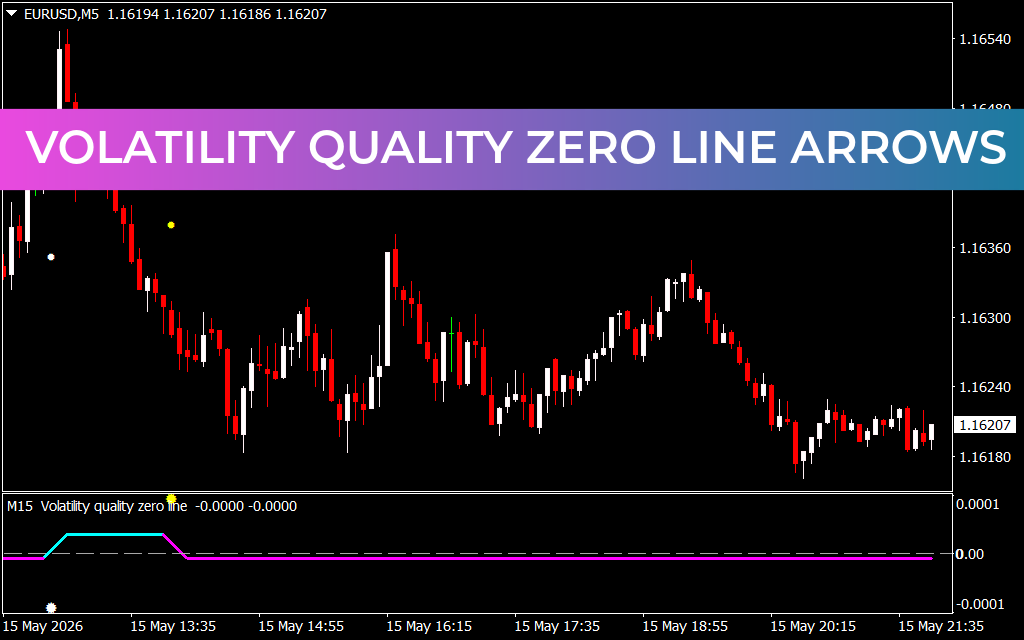
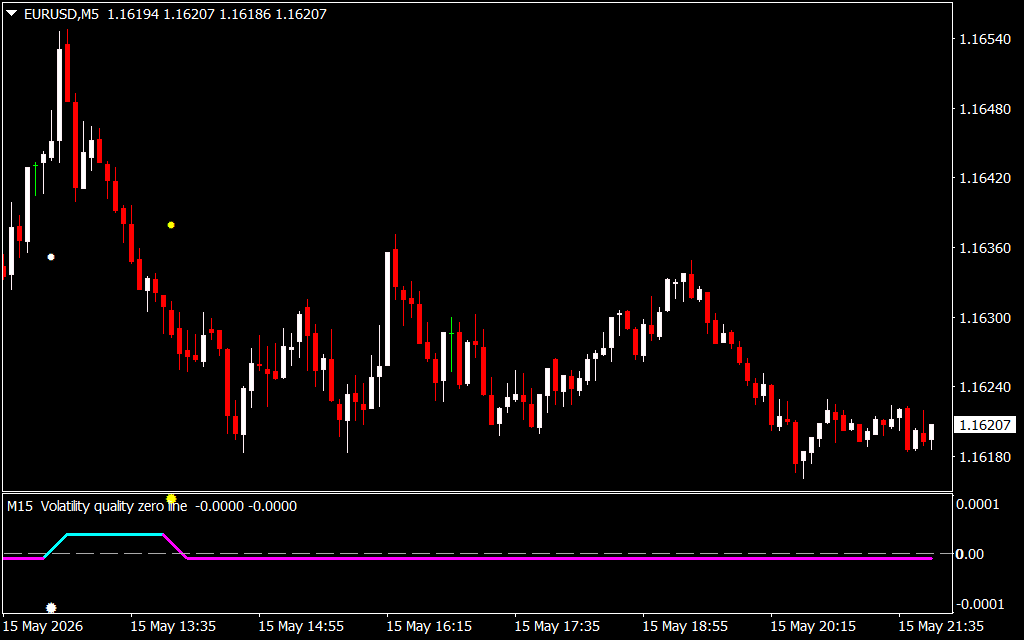
As demonstrated on the EUR/USD 5-minute workspace, the indicator runs flawlessly in a sub-window beneath the main candlestick window, condensing volatile macro-structural changes into a clean, horizontal signal path:
- The Zero-Axis Boundary (0.00): The horizontal dashed center line serves as the absolute point of validation. When the indicator path flatlines precisely on this axis, it warns day traders that the asset lacks directional quality, advising them to protect capital and stand aside.
- The Bullish Expansion Track (Thick Cyan Line): When buyers successfully spark a high-volume breakout, the indicator line crosses above zero and turns a solid cyan color. This visual change confirms that the upward momentum possesses authentic institutional backing.
- The Bearish Liquidation Track (Thick Magenta Line): Conversely, as institutional distribution forces the asset lower, the indicator drops below the zero threshold and shifts to a solid magenta color. This track signals that a high-quality downtrend is firmly underway.
Strategic Guidelines for Active Execution Terminals
To maximize the mathematical edge provided by the Volatility Quality Zero Line system on your execution screens, implement these professional principles:
- Strategic Entry Crossings: Prime your execution setups the exact moment the indicator path shifts color and crosses the zero baseline. Entering long on a fresh cyan crossover—or short on a fresh magenta crossover—ensures you join a trend right as market velocity establishes structural efficiency.
- Eliminating Consolidation Churn: During periods when the indicator line remains narrow and repeatedly hugs or flatlines against the zero axis, suspend all trend-continuation models. This behavior signals a quiet range block where standard systems face a high risk of getting chewed up.
- Trailing Stop Placement: Use the indicator's structural shifts to manage open risk. If you are holding a short position, you can confidently trail your stop-loss order behind recent swing highs for as long as the sub-window line remains safely locked in a thick magenta state beneath the zero axis.
7 Downloads
Last Update:
May 17, 2026 02:22 AM
Published:
Jan 20, 2026 22:34 PM
Category: