Trading High-Confluence Zones: Mastering Market Geometry with the Fibonacci Cluster Indicator
In the financial markets, single Support And Resistance lines often fail to paint the full picture of institutional liquidity. Retail traders who rely on isolated key levels frequently suffer from premature entries or missed breakouts. The Fibonacci Cluster Indicator for MT4/MT5 addresses this challenge by applying advanced geometric modeling to the chart field. By automatically overlaying multiple Fibonacci retracement and expansion structures from distinct historical swing legs, this powerful tool isolates tight pricing zones where multiple lines overlap—creating high-confluence horizontal grids that reveal the market’s true turning points.
Mapping Structural Confluence on the EUR/USD H1 Chart
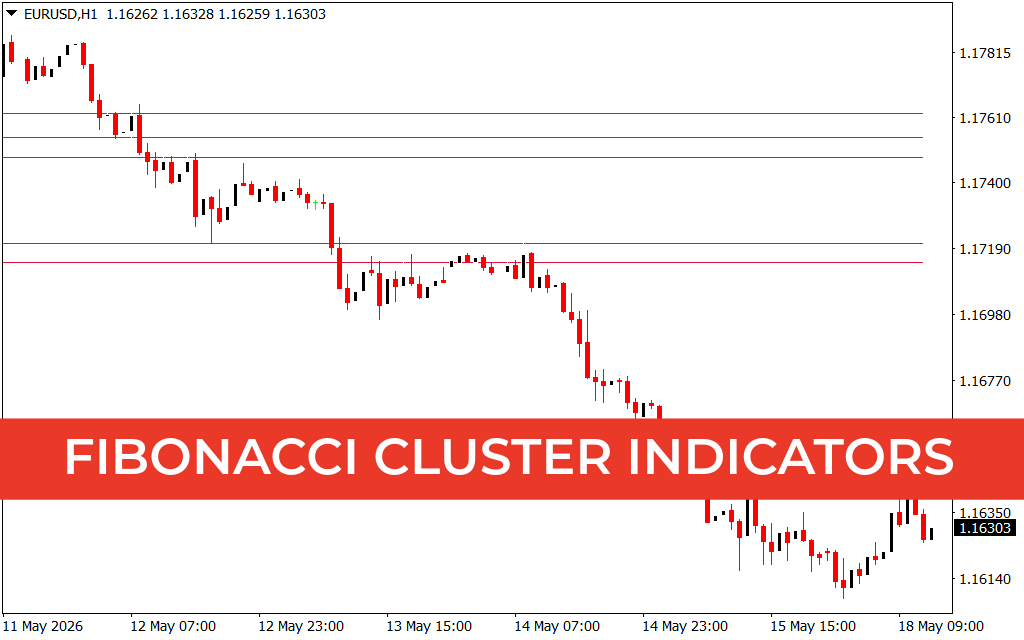
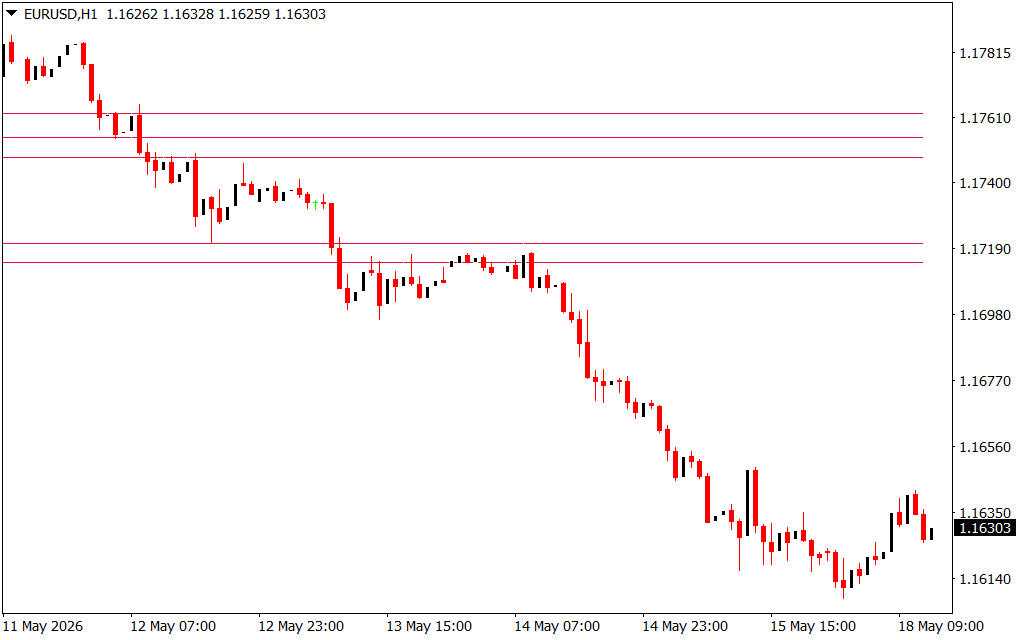
The provided EUR/USD 1-hour (H1) chart demonstrates how the Fibonacci Cluster framework maps macro order flow over an extended multi-day trading session. During the initial distribution phase starting on May 11, the currency pair initiated a steady markdown out of the 1.17815 liquidity pool.
Rather than treating the descent as a single movement, the indicator identifies individual internal swing structures. As the asset dropped, it established localized clusters. Notice the tightly grouped horizontal red lines plotted across the historical price field, specifically concentrated near the 1.17190 and 1.17610 levels.
In technical analysis, a single Fibonacci line can be ignored by institutional algorithms, but a cluster signifies mathematical harmony. When multiple retracement levels converge within a few pips of each other, it forms an incredibly dense barrier. On May 13 and 14, as the price attempted minor corrective pullbacks, it ran directly into these forward-projected clusters, stalling out precisely at the overhead resistance lines before collapsing into a fresh markdown leg toward 1.16140.
Managing Risk and Target Projections in Trend Rotations
The true edge of the Fibonacci Cluster indicator unfolds when a market reaches structural exhaustion and undergoes a trend rotation. Following the final selling climax on May 15, the asset entered an accumulation phase and began driving upward during the morning session of May 18.
Currently trading at 1.16303, the asset is pushing through localized minor levels. For day traders and swing operators, the forward-projected clusters serve a dual purpose: precise invalidation zones and objective profit targets. A long position initiated off the accumulation floor can be protected by placing a stop-loss directly below the lowest cluster band. Conversely, as the upward momentum expands, traders can look at the historical clusters near 1.17190 as high-probability trouble areas to lock in partial profits or trail stop-losses.
By integrating the Fibonacci Cluster indicator into your daily routine, you move away from the subjectivity of drawing single lines. It transforms your trading terminal into a clean, algorithmic workspace that maps institutional Supply And Demand zones automatically, giving you the precision needed to execute trades with complete confidence.
10 Downloads
Last Update:
May 18, 2026 16:30 PM
Published:
Jan 20, 2026 12:57 PM
Category: